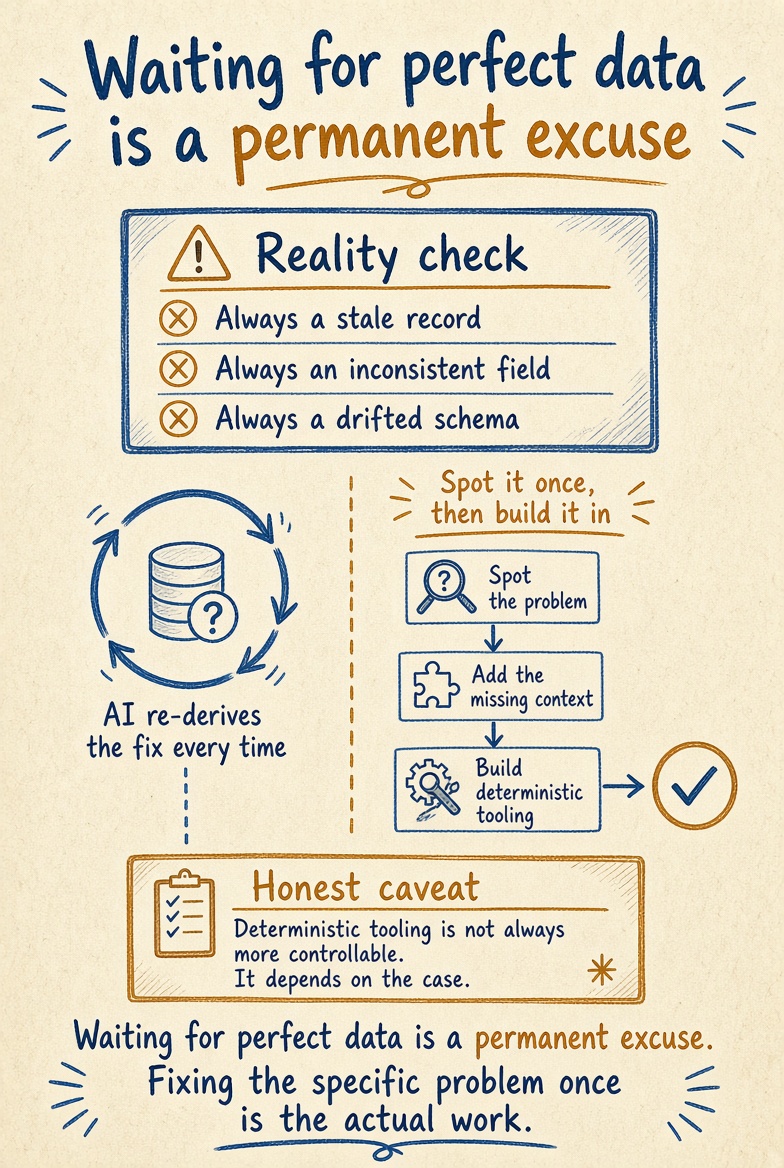
An organisation that waits for its data to be fully correct before adopting AI will never adopt. I do not mean that as a criticism. I mean it as a description of how large-organisation data actually works: data quality is not a precondition you clear once. It is an ongoing condition, ordinary, ever-present, and permanent in exactly the way a fixed launch date is not.
If "the data isn't ready yet" is the standard, it will always be true, because there will always be a field that is inconsistent, a record that is stale, a schema that drifted after the system that produced it changed. Treating that as a gate before starting is not caution. It is deferring indefinitely against a bar that was never actually defined and will never be reached, because nobody wrote down what "ready" would even mean.
When someone does spot a specific data problem, a misclassified field, a report that quietly means something different than its label says, the fix is not to retrain everyone in the organisation on the nuance of that schema. The fix is one person spotting it, adding the missing context once, and, where the correction is stable enough to be a rule rather than a judgement call, building it into tested, deterministic tooling rather than asking an AI to reinterpret the same fix from scratch every single time it comes up.
This connects directly to my own background. Smile, the AI governance gateway we are building at CyberSentriq, follows exactly this pattern: use AI once, to help build or update a piece of deterministic companion tooling from a spotted correction, rather than having AI re-derive the same interpretation every time the case recurs. That is not because deterministic tooling is always more controllable than AI judgement in some absolute sense, it depends on the case, and pretending otherwise would overclaim a debate that is genuinely still open. It is because a correction you have already understood once does not need to be re-understood every time, by a human or by AI.
Waiting for the data to be perfect is a permanent excuse. Spotting the specific problem and fixing it once, properly, is the actual work.