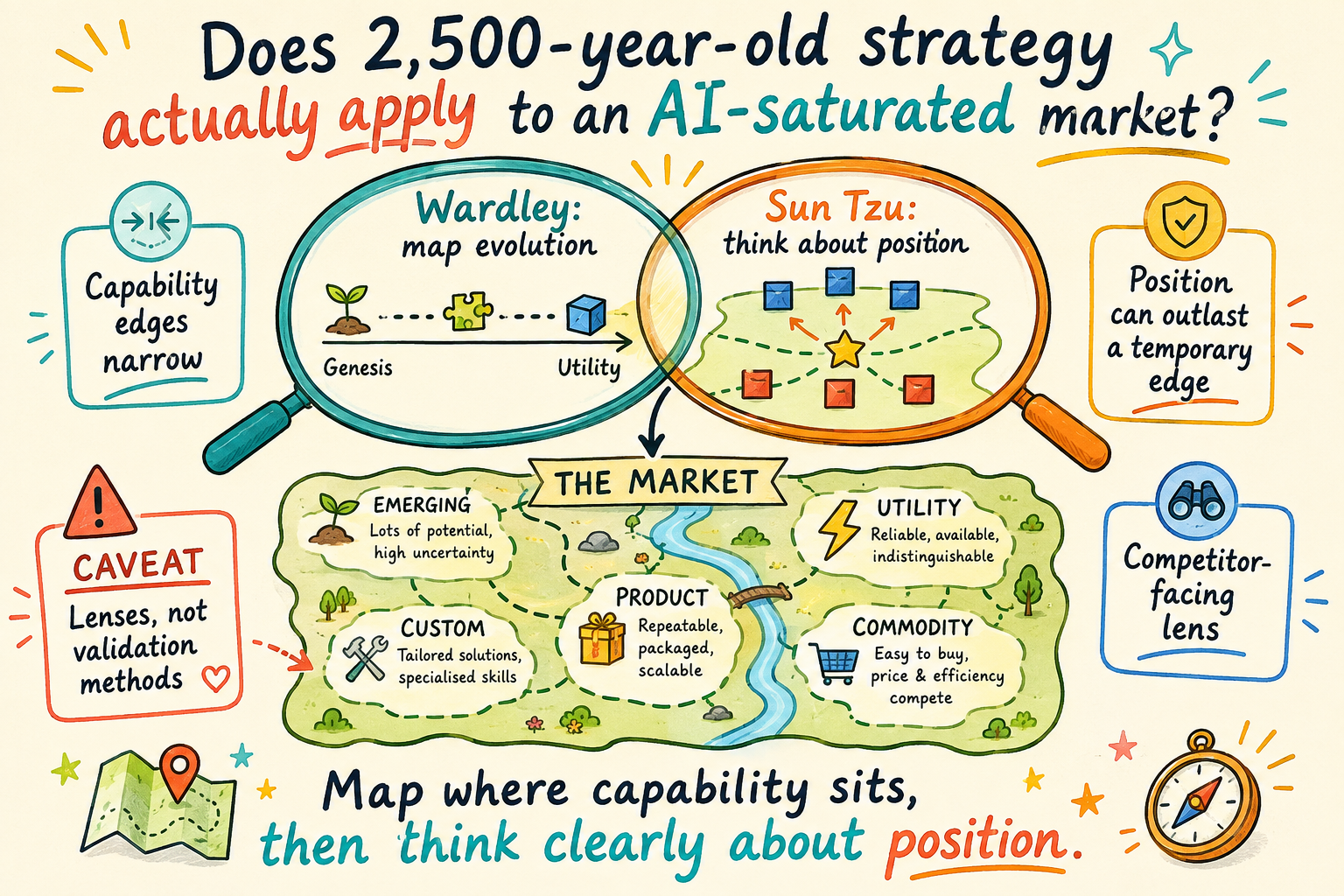
Two very different traditions keep showing up when I think about competing in a market where AI has compressed the advantage everyone used to rely on. One is two and a half thousand years old. The other is barely two decades old.
Wardley Mapping situates every component of a business, a capability, a tool, a process, on an explicit axis from genesis to commodity: how novel or how standardised it has become. The AI-era version of that question is not new, it is the same question technology has always asked, applied to a market moving faster than most maps can be redrawn. The useful discipline is the axis itself: knowing where a given capability sits between "nobody has this yet" and "everybody has this and it is a utility" changes what you should actually be doing with it.
Sun Tzu's classical doctrine, applied to competitors specifically, is about information advantage, positioning before confrontation, and winning the position rather than the fight. In a market where capability differences between AI tools narrow by the month, position, who understands the actual problem, who has the trust, who got there first with the right scope, matters more than a temporary technical edge that a competitor closes in a quarter.
Both are lenses: ways of diagnosing where a capability sits and how to think about position, not a new authority replacing the reasoning already in place. Old wisdom meeting a new problem is a genuinely interesting question. Whether it holds up rests on doing the comparison honestly rather than reaching for whichever ancient quote sounds good, and that is the standard I am holding this to.