I am not a lawyer. For a long time that meant treating "legal" as one blunt no-go zone: anything that touched law, leave alone, hand off, don't even draft a first pass. That is the wrong boundary, and it costs more than it protects.
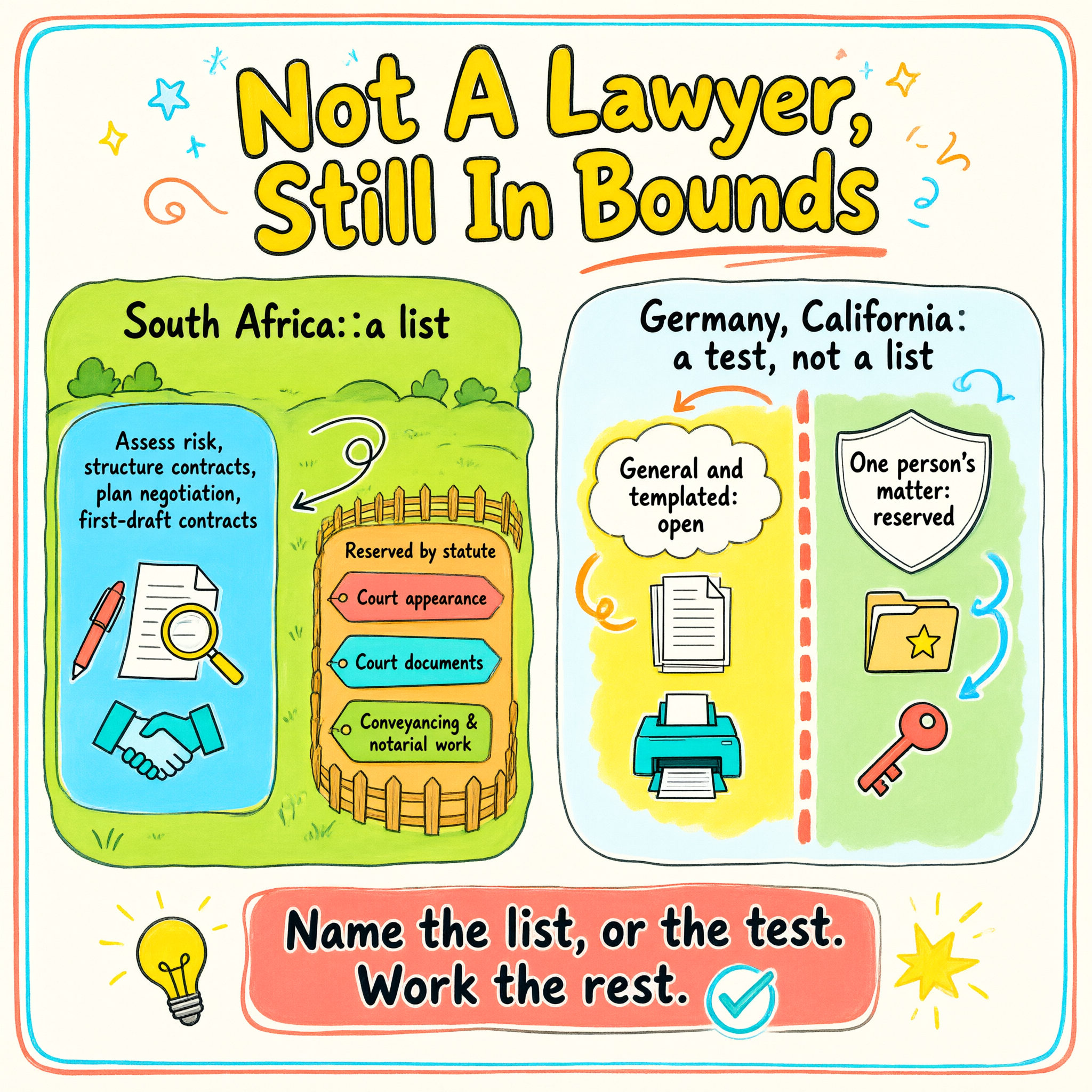
In South Africa, where I work, the Legal Practice Act reserves three things for remuneration: appearing in a court or tribunal where only a practitioner may appear, preparing documents for those proceedings, and anything another law hands specifically to advocates, attorneys, conveyancers, or notaries. That third part pulls in reservations from other legislation, so the boundary is a statutory core plus whatever is stitched on from elsewhere.
That is not how every jurisdiction draws the line, and it matters if you are tempted to treat "reserved acts" as one portable idea. England and Wales also use a list: six named activities in the Legal Services Act. Germany and California use a concept instead. Germany reserves anything that requires examining someone's individual legal matter. California requires a licence to practise law and never lists what that consists of.
A list lets you be surgical up front. Read the reserved acts and work the rest: risk assessment, contract structuring, negotiation strategy, a first draft of a contract for a lawyer to tighten. In South Africa none of that requires a licence.
A concept makes you surgical one piece of work at a time. The test is whether the work is general and templated, or assesses one person's specific matter. Germany's federal court applied that test to software in 2021: a standardised contract generator answering a user's questions was not a legal service, because it examined no individual case. The same negotiation strategy written for one client's dispute may land on the other side of the line.
The statute is not the only thing in the way. As I read it, in a concept jurisdiction the test is applied after the fact, so the uncertainty sits with whoever does the work. Referral habits, indemnity cover, and what clients have always been told keep ground closed even where no law reserves it. Those informal fences move with track record. The statutory core moves too, in both directions: Utah and Arizona opened routes for non-lawyer ownership, while Washington built a licensed programme for non-lawyers and then voted to shut it down.
My own reading is that the reservations that move are the ones justified by competence, protecting people from unqualified service, and competence is the gap AI is closing. Court representation is different. It exists so one named, licensed person answers for the outcome. That is an accountability question, and closing a competence gap does not touch it.
None of this says the reserved core will shrink, or that it should. Name the reserved list, or the test, for the place you are actually standing in, rather than treating the whole territory as gated the same way everywhere.