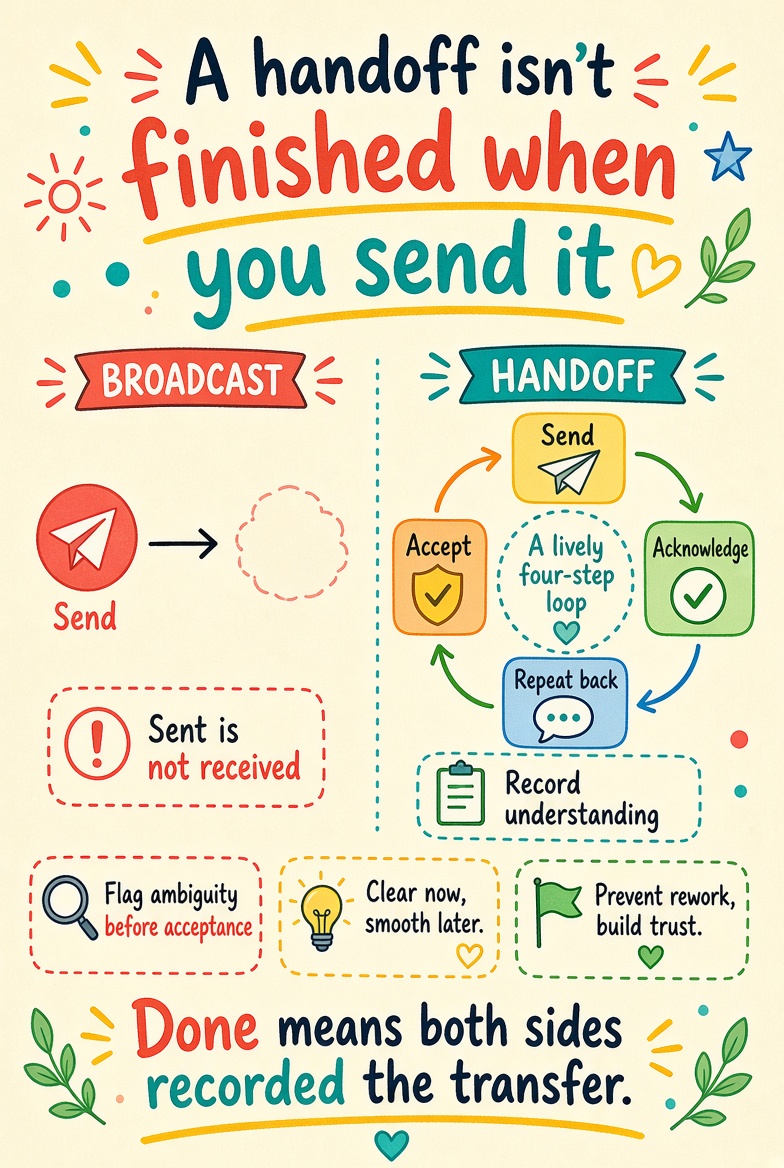
You have sent an email assuming it was read. You have delegated a task assuming it was picked up. You have told someone something important in a hallway conversation, certain it landed, only to find out weeks later that it did not. None of this is really about email or hallways. It is about a mistake we make constantly: treating a handoff as complete the moment it is sent.
A handoff is not a one-way act. It is not finished when the sending party has said their part. It is finished when the receiving party has acknowledged what they received, and can say back what it was. Until that happens, you have a broadcast, not a handoff, and the two look identical from the sender's side. That is exactly what makes the failure invisible. Nobody notices a broadcast has failed until the thing that should have moved does not.
This is easy to see in ordinary work and easy to miss in systems built to move fast. When a task, a decision, or a piece of governance passes from one person to another, or from one AI agent to another, the accountability for what happens next should only begin once the receiving side has confirmed the transfer and flagged anything unclear before accepting it. A system that only checks whether something was sent, and never checks whether it was received and understood, has a structural blind spot that will eventually cost it exactly when the stakes are highest.
The fix is not more communication. It is a different definition of done. A handoff is complete when both sides have recorded it, not when one side has finished their part and moved on.