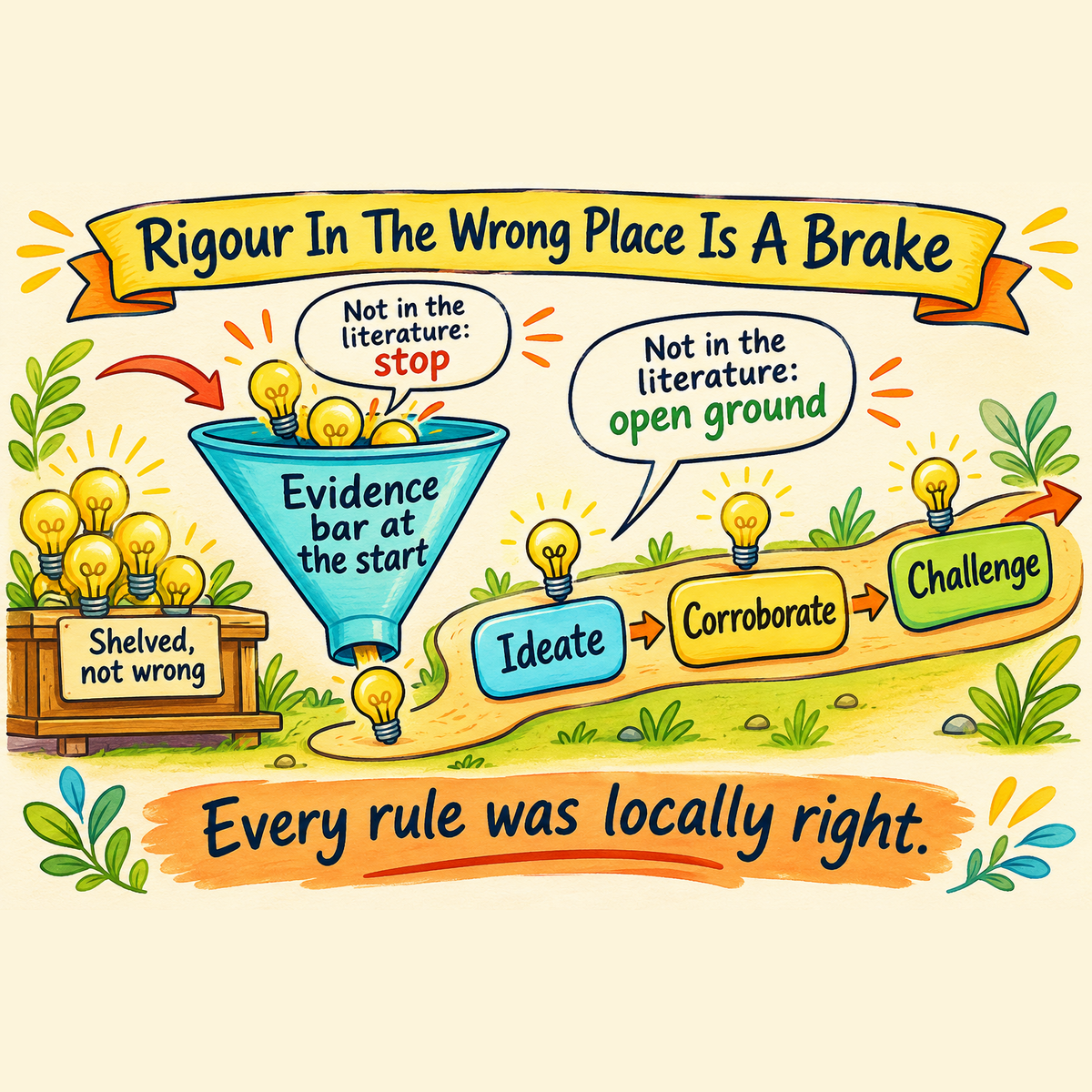
For months my research process ran in strict challenge mode, testing every idea as if it were about to be published, while I work mainly in ideation mode, looking for ideas worth testing. Two modes pulling against each other made it feel like a rollercoaster, and it took me a while to see why.
It did not start that way. At first, citations were checked again and again, and there were still gaps. Agents lost context and rechecked what had already been checked. So the rules came, each added to stop one failure: a bad claim reaching publication. Every citation was checked against its source. Questions were worded so as not to lead. I looked for agreement across several models, counted absence as a finding, discounted what only one model said, and discounted agreement that merely echoed my own framing. Each rule made sense alone.
Together they turned the research role into a gatekeeper whose default answer was "not yet proven", applied at the start of the process instead of the end.
It surfaced over a simple question: what do job postings for senior AI roles ask for? It was judged unsuitable for the model panel because postings expire and would fail the citation checks. The bar had been set by the channel, not by what the answer was for.
The same answer means opposite things depending on what you are trying to do. Under the strict template, "not in the literature" became a reason not to progress something. For ideation, it is exactly what you want. The search had found open ground, and the process read it as a dead end.
So the work now runs in order: ideate, then corroborate, then challenge. Every question declares its stage. Ideas never become published facts without corroboration, but they no longer have to pass the evidence bar before they may be thought.
Ten agents re-read the research notes written since June, looking for ideas that had been set down because they were unproven, not novel, or single-model, rather than because they were wrong. They found about 300 distinct ideas. Several conclusions I had reached independently the same day were already there, sitting in notes from months earlier. Challenge mode had not killed those ideas. It had shelved them.
I built this filter myself, out of good intentions, and every rule in it was locally right. That makes it harder to see than bureaucracy, and harder to argue with one rule at a time. Governance you believe in can still filter out your future.
It is also one process, mine, and the fix is new. The opposite failure is still real: unproven ideas drifting into published fact. The staging exists to prevent that, and I will find out over time whether it does.