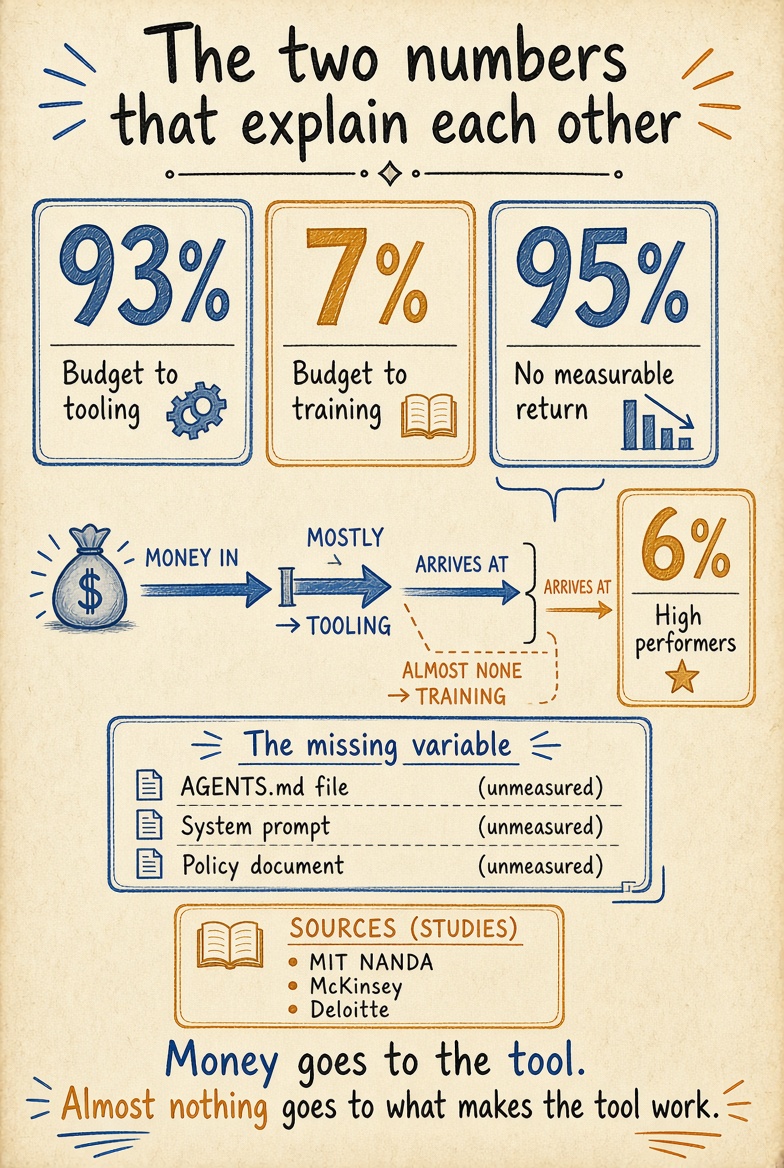
Ninety-three per cent of enterprise AI budgets go to technology. Seven per cent goes to people (Deloitte, Tech Trends 2026). Ninety-five per cent of organisations report no measurable return from their AI investment (MIT NANDA, The GenAI Divide, July 2025). Those are two separate studies, measuring two separate things, and I am not claiming one caused the other. But put them next to each other and the ratio does most of the arguing by itself.
McKinsey's own 2025 survey found that roughly six per cent of organisations qualify as what it calls high performers, seeing outsized value from AI. Three different studies, three different methodologies, three different samples. What they place side by side, without measuring the same thing at all, is substantial spending on technology, limited spending on people, and a small group reporting outsized value.
Here is what none of the three studies measured: the quality of the instructions and governing documents that direct the AI systems in the first place. Adoption frameworks measure whether AI is used, how deeply, and what it produces. None of the mainstream measurement literature treats the structural quality of the instruction itself, the AGENTS.md file, the system prompt, the policy document, as a variable in whether adoption succeeds. It is the one input closest to fully within an organisation's control, and it is the one nobody is measuring.